
Massage Therapy
Lipedema & the Caribbean Plate: A Gentler Approach to Understanding Food and Whole-Body Health
Nov
Exploring the role of everyday food choices as part of informed, comprehensive lipedema management.
When living with lipedema, do you really have to give up the foods you know and love?
For many women across Trinidad and Tobago and the wider Caribbean, food is more than nourishment. It’s part of our culture, our family gatherings and our everyday lives.
From freshly prepared kingfish and callaloo to ground provisions, channa, pelau and our traditional Sunday lunch, Caribbean cuisine offers an abundance of familiar ingredients.
But when someone is diagnosed with lipedema—or begins to suspect they may have it—food can suddenly become a source of confusion.
Should carbohydrates be avoided? Is rice contributing to swelling? Does every woman with lipedema need an anti-inflammatory diet? Could certain foods make the condition worse?
These are understandable questions, especially when social media is filled with conflicting nutritional advice.
At Kneading to Relax (KTR), we believe the first step is understanding lipedema itself.
Rather than telling women what they should or shouldn’t eat, we want to encourage informed conversations about nourishment, symptom awareness and the importance of appropriate clinical care.
Because managing lipedema involves much more than what is on your plate.
Understanding Lipedema: Why Food Is Only Part of the Conversation
Lipedema is a chronic condition characterized by disproportionate fatty tissue, commonly affecting the legs, thighs and hips, and sometimes the arms.
It occurs predominantly in women and may be associated with:
-
Pain and tenderness in affected tissues
-
Feelings of heaviness or discomfort
-
Easy bruising
-
Changes in body proportions
-
Reduced mobility or difficulty with certain activities
-
Swelling, particularly where other circulatory or lymphatic conditions coexist
One of the most important distinctions is that lipedema is not simply the result of overeating, inactivity or excess body weight.
Affected tissue may respond differently to conventional weight-loss measures than other fatty tissue.
This can be frustrating for individuals who have spent years attempting to change their body shape through various approaches.
However, it doesn’t mean food choices or metabolic health are irrelevant.
Maintaining overall health, addressing coexisting conditions and preserving mobility remain important parts of long-term care.
The goal is to understand the condition—not to place blame on the individual or their eating habits.
Where Does Nutrition Fit Into Lipedema Management?
Nutrition is increasingly discussed as one component of conservative lipedema management.
Research has explored various nutritional approaches, including Mediterranean-style and lower-carbohydrate eating patterns, to better understand their potential influence on symptoms and quality of life.
Although some findings are encouraging, the available evidence is still developing.
There is currently no single nutritional approach proven to cure lipedema or eliminate affected fatty tissue.
For this reason, individualized nutritional treatment belongs within the care of an appropriately qualified dietitian or other licensed healthcare professional working within their scope of practice.
From a clinical lymphatic therapy perspective, our role at KTR is to help individuals understand how lifestyle, movement, symptom awareness, compression and appropriate conservative management can contribute to their overall care.
Food is one part of that wider conversation.
Looking at Our Caribbean Foods With a Fresh Perspective
One positive aspect of living in the Caribbean is the variety of locally available foods.
Our markets, fishing communities and traditional kitchens offer ingredients that can contribute to varied, balanced meals.
Consider some of our familiar choices.
Fresh Fish and Seafood
Kingfish, carite, red snapper, cavalli, flying fish, banga mary, shrimp and crab are all familiar parts of Caribbean cuisine.
These foods provide protein, which is important for maintaining muscle and supporting normal tissue function.
For individuals living with chronic discomfort or mobility challenges, preserving muscle strength and physical function is particularly relevant to overall well-being.
Traditional Meats, Eggs and Legumes
Chicken, eggs, lean cuts of beef, goat and pork are also familiar protein sources.
Plant-based favourites such as channa, pigeon peas, lentils and red beans contribute protein, fiber and other nutrients.
These ingredients can be incorporated into meals according to individual needs, preferences and medical considerations.
Our Vegetables and Ground Provisions
Callaloo, bhagi, ochro, cabbage, patchoi, christophene, pumpkin and locally grown vegetables bring variety, fiber and micronutrients to the table.
Ground provisions such as sweet potato, dasheen, yam, green fig, eddoes and breadfruit provide carbohydrates and other nutrients.
The important message is that these traditional foods do not automatically need to be excluded simply because someone has lipedema.
Their place in an individual’s eating pattern should be considered within their overall nutritional needs.
The Way We Prepare Food Matters Too
Caribbean cooking is full of flavour.
Fresh green seasoning, chadon beni, garlic, thyme, ginger, pimento and lime are wonderful examples of ingredients used in our traditional kitchens.
The frequency of heavily processed meals, excessive dietary sodium and sugary beverages can influence general health and, in some individuals, fluid retention.
That doesn’t mean a person must abandon traditional recipes.
It simply encourages greater awareness of everyday habits and how they fit into overall health.
Our Caribbean food culture can be part of a positive conversation about nourishment—not automatically viewed as something that must be corrected.
Does Food Cause Lipedema Swelling or Pain?
This is an important question, and one that deserves a careful answer.
Some individuals living with lipedema report changes in how their bodies feel after particular meals.
However, a personal observation doesn’t necessarily establish that a specific food caused a symptom.
Lipedema-related pain, heaviness and changes in limb size can have several contributing factors.
Hormonal changes, prolonged standing, physical activity, medications, coexisting venous or lymphatic conditions and other health concerns may influence symptoms.
Not all swelling is caused by lipedema, and not all lipedema symptoms are related to fluid accumulation.
There is also no scientifically established universal list of foods that trigger lipedema symptoms in everyone.
This is why blanket recommendations to eliminate dairy, gluten, tomatoes, fruit or entire food groups should be approached with caution.
When someone suspects that food is influencing their symptoms, a qualified dietitian can help assess their nutritional needs and investigate potential associations.
At KTR, we encourage individuals to become more aware of their symptoms while seeking appropriate professional guidance rather than attempting to manage everything through dietary restriction.
Why a Whole-Body Approach Matters
Lipedema affects more than appearance.
For many women, it influences comfort, confidence, mobility, physical activity and everyday quality of life.
This is why conservative management should be individualized.
International lipedema guidance recognizes several important components of care, including appropriate physical activity, compression, lifestyle support and clinical interventions when indicated.
At Kneading to Relax, our focus includes:
Clinical Lymphatic Therapy (MLD/CDT)
Manual lymphatic drainage and other decongestive approaches may assist with associated fluid accumulation and discomfort in selected individuals.
It’s important to understand that manual lymphatic drainage does not remove lipedema fat.
Compression Therapy
Appropriately selected compression garments may help manage discomfort, heaviness and associated swelling.
Garment selection and fitting should take account of the person’s clinical needs and tolerance.
Movement and Physical Function
Suitable activities such as walking, aquatic exercise and progressive strengthening can contribute to mobility, muscle function and overall well-being.
Activity recommendations should be adapted to individual abilities and medical considerations.
Education and Symptom Awareness
Understanding the difference between lipedema, lymphedema and other causes of swelling is important.
Recognizing changes in symptoms and knowing when medical evaluation is necessary can help individuals access appropriate care.
Collaborative Healthcare
Effective management may involve physicians, qualified dietitians, physical therapists and other healthcare professionals working together.
There is no single treatment or lifestyle intervention that addresses every aspect of lipedema.
A Gentle Reminder: Your Health Is More Than a Number on the Scale
For women living with lipedema, the journey toward understanding their bodies can be challenging.
Some have spent years being told to lose weight without receiving an explanation for their pain, disproportionate limb size or other symptoms.
Others may be newly diagnosed and searching for answers.
What matters is having access to reliable information, realistic expectations and the right professional support.
Food is an important part of overall health, but it should not become another source of blame or confusion.
Our Caribbean traditions, familiar ingredients and everyday meals can remain part of that conversation.
And where individualized dietary changes are necessary, they should be guided by an appropriately qualified professional.
Lipedema management is not about pursuing a perfect plate. It’s about understanding the condition, supporting function and improving quality of life through informed, individualized care.
Our Commitment at Kneading to Relax
As a Certified Lymphedema Therapist practising since 2010, I have seen the importance of education in helping individuals better understand lymphatic conditions and their management.
Through the KTR Lipedema Education Series, our aim is to make reliable, accessible information available to women and families throughout Trinidad and Tobago and the wider Caribbean.
We want to encourage earlier conversations, appropriate assessment, better understanding of symptoms and greater awareness of conservative management options.
This educational series is not a dietary programme.
It is an invitation to become better informed about lipedema and the different aspects of living with the condition.
Understand your condition. Support your health. Make informed choices.
Because at Kneading to Relax:
Lymphatic health is whole-body health.
Continue Learning With KTR
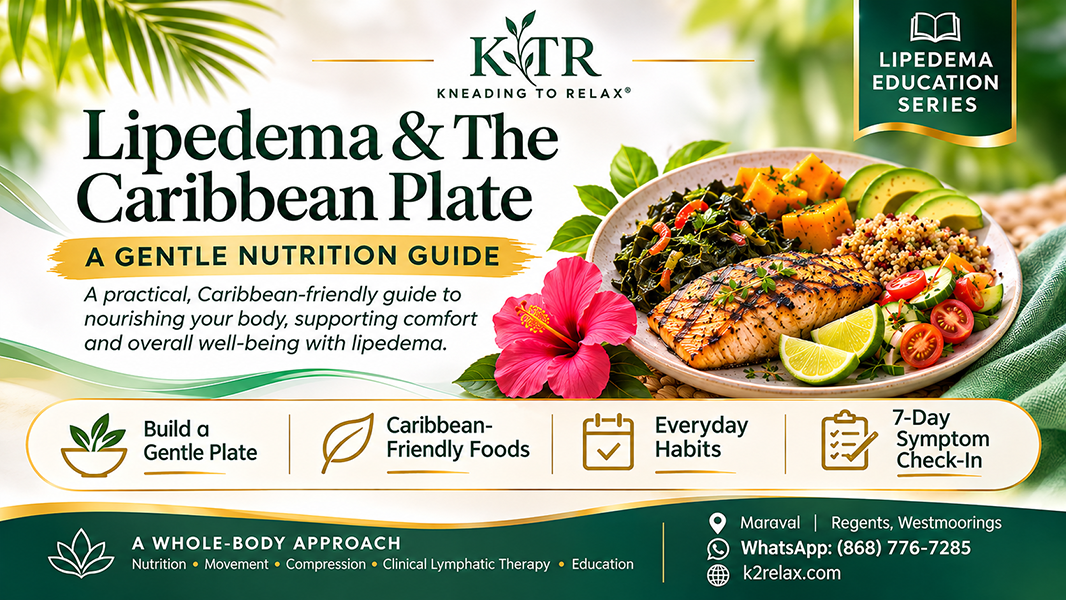
Our Gentle Nutrition Guide offers an introductory look at Caribbean food choices, everyday wellness habits and symptom awareness.
It is intended as an educational resource—not a prescribed diet or nutritional treatment plan.
For individuals seeking clinical support, Kneading to Relax provides:
-
Clinical Lymphatic Therapy (MLD/CDT)
-
Lipedema-focused assessment and conservative management education
-
Compression guidance and fitting
-
Individualized support within our clinical scope
Kneading to Relax
Maraval | Regents Medical Clinic, Westmoorings
WhatsApp: (868) 776-7285
Website: www.k2relax.com
